AI at UND's School of Medicine & Health Sciences
We see AI as a strategic opportunity and a responsibility: to improve health, strengthen the healthcare workforce, and advance well-being for the people of North Dakota.
Artificial intelligence is rapidly reshaping healthcare, health sciences education, biomedical discovery, and the ways professionals learn, work, and serve. At the University of North Dakota School of Medicine & Health Sciences, we see AI as both a strategic opportunity and a responsibility: to improve health, strengthen the health care workforce, and advance the well-being of North Dakota and the region.
As the only school of medicine and health sciences serving North Dakota, SMHS (in partnership with the College of Nursing and Professional Disciplines) is uniquely positioned to prepare students, faculty, staff, clinicians, and researchers for an AI-enabled future. This includes adapting curricula so graduates understand how AI is used in health care and biomedical research, how to evaluate it critically, and how to apply it responsibly in service of patients and communities, consistent with professional values and scientific advancement.
AI is also a research imperative. Used wisely, AI can expand access to care, support rural and underserved communities, reduce administrative burden, improve decision support, accelerate discovery, personalize learning, and help address complex health challenges. At the same time, AI systems can be inaccurate, biased, opaque, or misused. Our goal is to lead with imagination and caution, preserving human dignity, accountability, and community trust.
Through education, research, service, governance, and partnership, the UND School of Medicine & Health Sciences will help lead the responsible transformation of healthcare in the age of AI. We invite students, faculty, staff, clinicians, researchers, and community partners to join us in shaping an AI-enhanced future that is innovative, ethical, evidence-based, and deeply human.

The AI committees charged with advising leadership on the strategic integration of AI across the SMHS.
AI Resources within North Dakota's only interprofessional School of Medicine & Health Sciences.
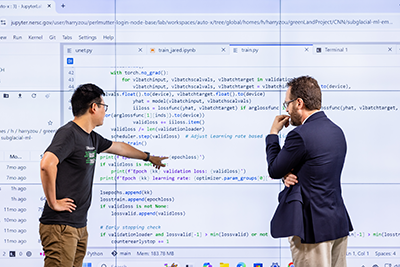
The SMHS AI Hub is a long-term plan to transform rural healthcare through AI development.
Details on Co.AI: The UND AI Moonshot.