Learners Improving Value Equation (LIVE)
To date, medical colleges and health providers have struggled to convert the training we give medical students and residents into improved patient care outcomes.
This disconnect is due, in part, to a lack of adequate education in the concepts of health system science and High Value Care (HVC) for our current and future healthcare workforce.
Internal Medicine residents who report being "exposed to teaching about high value care" during residency.
Medical students who felt "extremely or somewhat dissatisfied with their HVC education" during clerkships.
UND LIVE
To address this challenge, North Dakota's only interprofessional school of medicine and health sciences will partner with area health providers on its Learners Improving Value Education (LIVE) project.
UND LIVE will complement learner education in the basic and clinical sciences by adding a third pillar of medical education: health systems science.
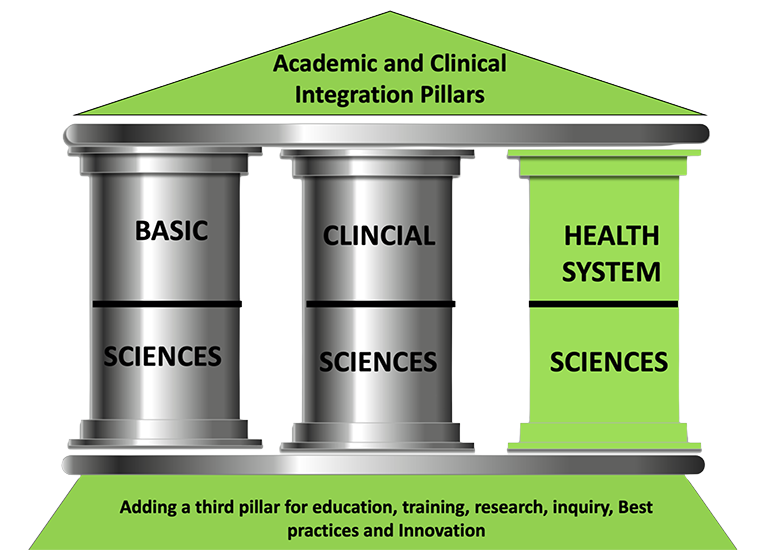
Under the guidance of a joint UND/health provider advisory board, UND LIVE will:
- Better train future physicians on health system operations and how high value care can help reduce healthcare costs and improve outcomes.
- Establish and maintain mutually beneficial healthcare education partnerships rooted in shared values, mutual respect, and trust.
- Assist with new programs, potential start-ups, and academic advancement.
LCME and High Value Care
Medical schools and health providers must both do a better job of training learners in HVC, especially because the Liaison Committee on Medical Education mandates it:
- Via Standard 7 (Curricular Content), LCME requires that medical schools "ensure that the medical curriculum provides content of sufficient breadth and depth to prepare medical students...for the subsequent contemporary practice of medicine."
- LCME also recommends curricula include Systems-Based Practice: Training students in HVC for understanding how to deliver care in a cost-effective manner. This ensures that medical education prepares students for the shift from volume-based to value-based (or, "outcomes-based") care.
ACGME on HVC education
Futhermore, the Accreditation Council for Graduate Medical Education (ACGME) requires physicians to understand how healthcare systems work and to practice cost-effectively and resource-efficiently, advocating for high-quality, cost-effective care.
- The ACGME's CLER (Clinical Learning Environment Review) Program, asks schools to evaluate clinical learning environments in areas like patient safety, quality improvement, and health care system improvements, directly influencing HVC training.