University of North Dakota
    • Current Students
    • Faculty & Staff
    • Alumni & Community
    • Email
    • Blackboard
    • Campus Connection
    • Employee Self-Service (HRMS)
    • Dropbox
    • Rooms & Scheduling
    • Zoom
    • Employee Remote Access
    • SMHS Leave/Travel Request
  • Directory
  • Featured Events
  • Library
  • Scope of this search:
School of Medicine & Health Sciences
  • About
  • Admissions
  • Education & Training
  • Research
  • Service
University of North Dakota
  • About
  • Admissions
  • Education & Training
  • Research
  • Service
  • Request Info
  • Visit
  • Apply
Scope of this search:
  • Request Info
  • Visit
  • Apply
Scope of this search:
School of Medicine & Health Sciences
  • Home
  • Research
  • Mass Spectrometry
  • Adenosine Quantification
Skip Section Navigation
  • Mass Spectrometry
  • Instruments
  • Policies
  • Services

Adenosine Quantification

The standard curve
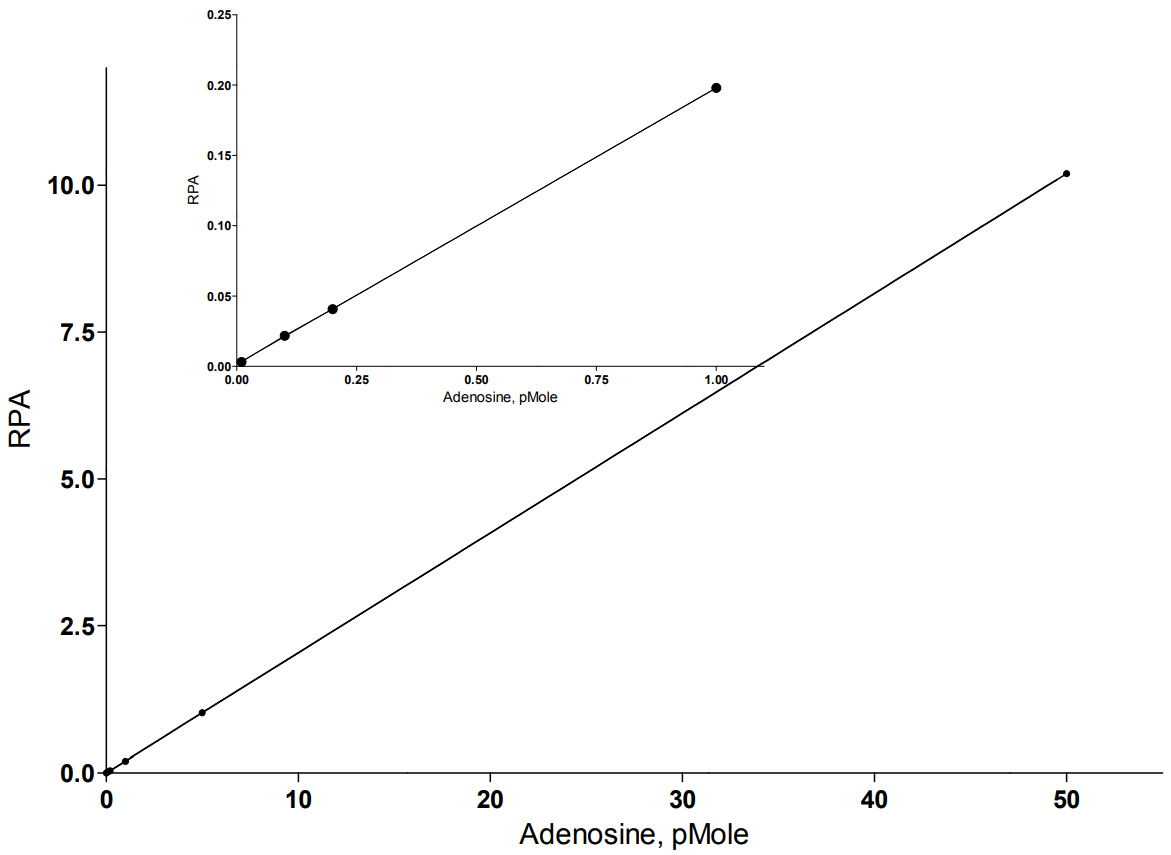
A chart showing the standard curve for adenosine quantification

Standard curve for adenosine quantification was build against a stable isotope labeled internal standard
(ribose-13C5-adenine, 5pMole). RPA – relative peak area, defined as adenosine peak area divided by
internal standard peak area; R square=1.

Reverse-phase LC electrospray ionization mass spectrometry method was developed for adenosine quantification. The HPLC was carried out using a Luna C-18(2) (3 μm column, 100 A pore diameter, 150 x 2.0 mm) (Phenomenex, Torrance, CA, USA) with security guard cartridge system (C-18) (Phenomenex, Torrance, CA, USA). The system was consisted of an Agilent 1100 series LC pump with wellplate autosampler (Agilent Technologies, Santa Clara, CA). The autosampler was set at 4o C, and a chromatographic column temperature was maintained at 35oC. A 10 μL of sample was injected onto a chromatographic column.

The solvent program for elution was the modification of a previous method (1-2). This modification was made to decrease separation time and increase sensitivity of detection by increasing peak sharpness. The LC system was composed of 25mM ammonium acetate in water (solvent A) and acetonitrile (solvent B). The separation was carried out at flow rate 0.2 ml/min and isocratic concentration of solvent B (10%). The total separation time was 5 min, and no equilibration between runs was required.

MS analysis was performed using a quadrapole mass spectrometer (API3000, Applied Biosystem, Foster City, CA, USA) equipped with TurboIonSpray ionization source. Analyst software version 1.4.2 (Applied Biosystem) was used for instrument control, data acquisition, and data analysis. The mass spectrometer was optimized in the multiple reaction-monitoring mode. The source was operated in negative ion electrospray mode at 450oC, electrospray voltage was 5000 V, nebulizer and curtain gas were 8 L/min. Declustering, focusing, entrance,
focusing potential, and collision energy potentials were 30, 250, 10, and 30 V, respectively. The quadrupole mass spectrometer was operated at unit resolution. Adenosine was quantified against internal standard ribose-13C5-adenine (5pMole) added to brain tissue extract prior to analysis. Precursor/product ions used for quantification were 267.8/136.2 for adenosine, and 272.8/136.2 for ribose-13C5-adenine.

Mikhail Golovko, Ph.D.
Mass Spectrometry Director
Assistant Professor
Pharmacology, Physiology & Therapeutics
701.777.2305
mikhail.golovko@UND.edu

Svetlana Golovko
Research Specialist
701.777.3574
svetlana.golovko@UND.edu

We use cookies on this site to enhance your user experience.

By clicking any link on this page you are giving your consent for us to set cookies, Privacy Information.

School of Medicine & Health Sciences

1301 N Columbia Rd Stop 9037
Grand Forks, ND 58202-9037

701.777.2514

  • YouTube
  • Instagram
  • Facebook
  • Twitter
  • Policies
  • Bloodborne Pathogen Exposure
  • Campus Safety
  • SMHS Events Calendar
  • Accreditation
  • Maps & Parking
  • Make a Gift
  • Technology Resources
University of North Dakota

© 2026 University of North Dakota - Grand Forks, ND - Member of ND University System

  • Accessibility & Website Feedback
  • Terms of Use & Privacy
  • Notice of Nondiscrimination
  • Student Disclosure Information
  • Title IX
©