North Dakota Medicine
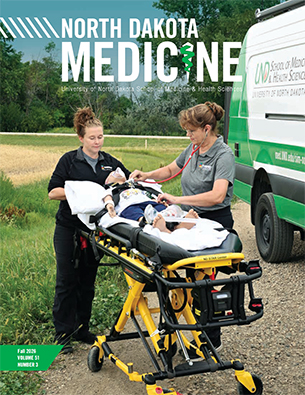
North Dakota Medicine is a quarterly print publication of the UND School of Medicine & Health Sciences.
From the Dean: Transforming healthcare training for North Dakota
It’s hard to believe that this fall marks a full decade since the UND School of Medicine & Health Sciences (SMHS) moved into its “new” home on the north side of UND’s campus. Ten years ago, North Dakota made a significant investment in the future of healthcare education by opening a building designed to bring our SMHS programs together under one roof.
Since joining UND and SMHS in December 2024, I have come to appreciate both the rich history of our School and the extraordinary role North Dakotans have played in its growth. Their support has allowed SMHS to educate generations of health professionals who now serve communities across our state and beyond.
Our footprint extends far beyond Grand Forks. We have regional campuses in Fargo, Bismarck, and Minot, and our learners receive excellent clinical training in communities throughout North Dakota. For decades, the people of this state have supported SMHS and trusted us to deliver on our Purpose: to serve North Dakota for the benefit of its people and to enhance the quality of their lives.
As we celebrate the past decade, we are also focused on what comes next.
The future of healthcare will require us to embrace new technologies while preserving something technology can never replace: human connection. Healthcare delivery is an amazing example of where technology intersects with humanity. Recent surveys indicate 78% of physicians utilize artificial intelligence (AI) in their work. Even so, I am confident AI will not replace the healthcare provider, in part because patients look to their physician for expertise and reassurance during some of the most vulnerable moments of their lives.
SMHS began preparing for this future with the launch of an AI Working Group in 2023. This aligns with the broader university initiatives on AI, which began in the mid 2010s and accelerated following the launch of ChatGPT in 2022 and led to UND President Andy Armacost’s declaration of the campus AI moonshot in 2025. SMHS is well positioned to help lead this effort by ensuring that our graduates understand how to use AI effectively and ethically.
Innovation is also reshaping how we educate our students. Our M.D. program recently launched the Curriculum Transformation and Innovation Initiative to modernize medical education and ensure UND SMHS remains at the forefront of preparing physicians for North Dakota’s evolving healthcare needs.
This initiative also allows us to launch the Primary Care Accelerated Track (PCAT) program in 2028. PCAT is a three-year M.D. program which will pathway students into family medicine and internal medicine residencies across the state. PCAT students receive a full scholarship to medical school and commit to practice in a rural community in North Dakota for five years.
Preparing the healthcare workforce of the future means more than educating individual professionals well, of course. It means teaching them to work well together.
In educating the next generation of health professionals, our faculty and staff are also providing opportunities for learners to understand one another’s roles and how to function as coordinated healthcare teams.
This collaborative approach to education is one of our great opportunities. It prepares graduates to enter practice understanding that patient care rarely comes from a single profession working in isolation.
To support state-of-the-art team training, we are working toward a 120,000-square-foot addition to our current building that will co-locate UND’s College of Nursing & Professional Disciplines—including nursing, social work, and nutrition and dietetics—into a shared health professions education environment. This Health Professions Education addition will include a state-of-the-art simulation center where students from multiple health professions train together in realistic clinical environments.
Importantly, this would not be a resource solely for UND. We envision it as a statewide resource, providing practicing health professionals with opportunities to train, develop new skills, and take those experiences back to the communities they serve.
With 36 critical access hospitals across North Dakota, rural healthcare is not a niche interest here – it’s a way of life. This planned expansion will be a gamechanger for our communities and for the health of North Dakotans for decades to come.
When we bring all of these efforts together, the bold vision emerging becomes clear: transformational training and workforce development occurring within world-class facilities.
Ten years ago, North Dakota invested in a building that helped transform health professions education.
Today, we have the opportunity to imagine what the next decade can bring.
Marjorie R. Jenkins, M.D., M.Ed.H.P., FACP
Vice President for Health Affairs, UND
Dean, School of Medicine & Health Sciences