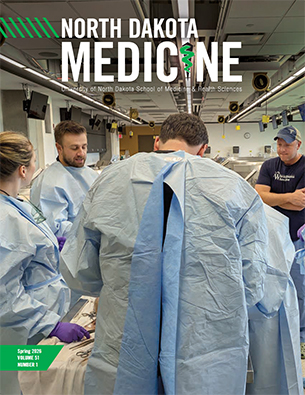
North Dakota Medicine
North Dakota Medicine is a quarterly print publication of the UND School of Medicine & Health Sciences.
From the Dean: Introducing the Primary care Accelerated Track
If there’s one goal linking each of the projects, events, and communications that North Dakota’s only interprofessional school of medicine and health sciences has initiated over the past year, it’s innovation. Innovation in how we recruit and retain students, innovation in the number of health providers to serve North Dakota, and innovation in the strategies and partnership that advance the overall health and well-being of our state.
The spirit of innovation challenges us to think differently and design solutions that meet the rapidly evolving needs of our communities.
By reimagining how we educate students, design and conduct research projects, and build strong interdisciplinary healthcare teams, we are not only advancing our mission, we are shaping the future of North Dakota.
In a way, the UND School of Medicine & Health Sciences has proposed one large project with several components, each as important as the others.
One clear example of how we are innovating nearly every day is through a program called the Primary Care Accelerated Track, or PCAT. This project segues from the ND85 initiative which seeks to reach 85% North Dakota students in our M.D. and physician assistant (PA) classes by 2030.
Initially PCAT will begin with students interested in the primary care specialties of family medicine and internal medicine, with the hope of expanding to additional specialties in the future.
This cohort of students will graduate medical school in only three years. Following the curriculum portion of the program, the cohort will enter a primary care post-graduate residency program in North Dakota and, after completing the residency, will practice in North Dakota for a minimum of five years.
This program is truly a way to get North Dakotans caring for North Dakotans. Students graduate into the state’s clinics and hospitals a year earlier, save on tuition and fees, and find a built-in practice ready for them post-residency. Furthermore, communities in the state get a minimum five-year commitment from these doctors to practice in one of North Dakota’s healthcare provider shortage areas.
Starting with our family medicine program, we hope to have PCAT up and running in communities across North Dakota by 2028. Having developed a similar fast-track program at the University of South Carolina School of Medicine at Greenville, I’m confident we can do this in North Dakota.
This is just one example of the many innovative initiatives we’re pursuing as we fulfill our mission to serve North Dakota for the benefit of its people and to enhance the quality of their lives.
And we’re just getting started.
Marjorie R. Jenkins, M.D., M.Ed.H.P., FACP
Vice President for Health Affairs, UND
Dean, School of Medicine & Health Sciences